Faster Transitions Start Before Race Day

Transitions are one of the most overlooked parts of triathlon.
Athletes spend countless hours training swimming, biking, and running—but very little time thinking about how to move efficiently between them. And while transitions may only account for a few minutes of your race, they’re often the easiest free speed available.
The athletes with the fastest transitions usually aren’t moving frantically. They’re calm, organized, and intentional.
That’s the goal.
Simplify Your Transition Area
One of the biggest mistakes athletes make is overcomplicating transition.
Your setup doesn’t need to look like a campsite.
It’s not a picnic.
Every extra item you bring into transition creates another opportunity for confusion, distraction, or delay. The more decisions you have to make during the race, the slower you become.
Keep it simple:
Helmet
Shoes
Nutrition
Race belt / hat
Essentials only
Everything should have a purpose and a place.
Transitions should feel automatic. You shouldn’t be searching through bags, moving towels around, or deciding what to grab next. The less visual clutter you create, the easier it is to execute under stress.
Know Exactly Where Your Bike Is
Nothing is slower than searching for your bike.
I’ve done it before. It’s a terrible feeling—running through transition, heart rate elevated, wetsuit half-off, completely disoriented while every bike rack suddenly looks identical.
Transition speed starts before race morning.
The day before the race, find landmarks:
A tree
A pole
A building corner
A port-o-potty
Anything visually obvious
Memorize the route from:
Swim in → bike
Bike in → run out
Don’t rely on counting rows or hoping you’ll recognize your setup during the chaos of race morning.
Walk through transition ahead of time. Practice the flow mentally. Preparation removes panic.
Swim to Bike (T1): Keep Moving
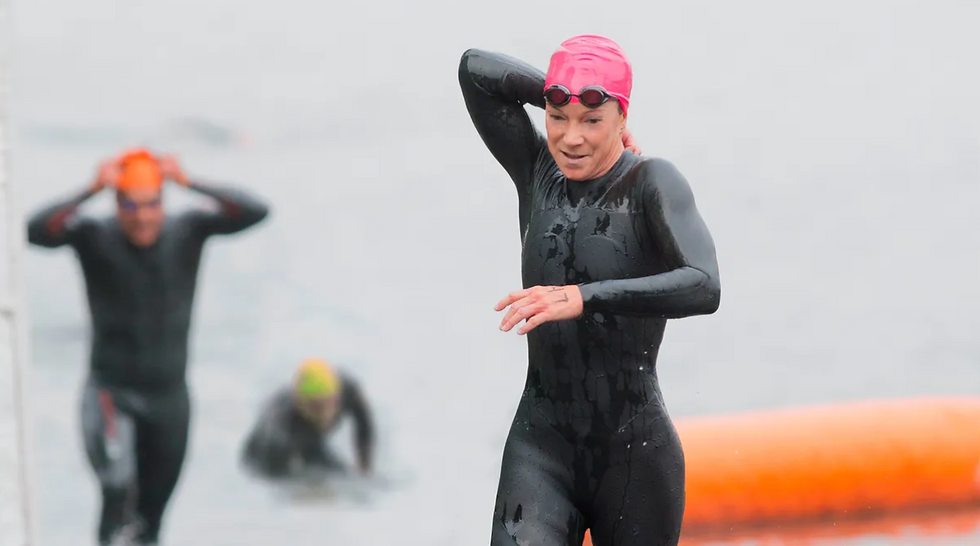
The biggest mistake athletes make in T1 is stopping unnecessarily.
Everything should feel like one continuous sequence.
As soon as you exit the water:
Remove cap and goggles immediately
As you pull your arm through your sleeve, release you cap and goggles there – now forget about them
Peel the wetsuit to your waist while running
By the time you reach your bike, you should only be focused on finishing the wetsuit removal.
A simple approach works best: Push from your waist down to your ankles, stomp on the material, pull one leg out, stomp on the other side, pull the other leg.
That’s it.
If wetsuit strippers are available in long-course racing and you’re comfortable using them, they can save both time and energy.
Once at the bike:
Helmet goes on first
Keep it unclipped and open on the aerobars ideally ready to grab and put on first
Optional: socks go on fastest when they are “pre-rolled” down. Simply get it to your mid-foot and unroll.
All nutrition and hydration should already be mounted on the bike
Transition should feel “grab and go,” all the preparing has been done before the race started.
And when running out with the bike, I personally prefer steering using the BTA bottle rather than the saddle. It gives better control and makes it easier to settle onto the aerobars smoothly after the mount line.
The key is eliminating standing still.
Bike to Run (T2): Stay Fluid

T2 is where athletes often lose focus mentally.
The ride is over, fatigue is setting in, and suddenly simple tasks feel harder than they should.
Again, simplicity wins.
About a mile out, make sure to switch to a higher cadence: this will help loosen up the legs, and get some blood pumping.
As you get closer to the transition area:
Get your feet on top of your shoes early if you’re comfortable doing that, keep pedaling, but be prepared to dismount
Stay relaxed and controlled
The moving dismount starts by swinging one leg over the saddle while the bike is still rolling.
Then stepping down and continuing with a run.
Practice before the race is critical!
At your rack:
Shoes and socks first (if using socks)
Grab your hat with everything already inside it
One of the best ways to simplify T2 is bundling nutrition together:
Tape gels and salt tabs into one package
Reduce the number of things you have to manage individually
Then keep moving:
Put nutrition into pockets while running
Hat on while moving
Race belt on while moving
T2 should feel fluid and continuous—not like a full reset before the run.
And if you’re newer to triathlon or not comfortable leaving shoes clipped into the bike yet, that’s okay. Simpler and smoother is always faster than rushed and chaotic.
Final Thought
Fast transitions aren’t about rushing.
They’re about preparation, simplicity, and repetition.
The best transitions happen when there’s no thinking left to do—just execution.
Simplify your setup. Know your landmarks. Build a repeatable sequence.
Because on race day, smooth is almost always faster than frantic.
Want free speed on race day without getting fitter?
At NVDM Coaching, we help endurance athletes optimize every part of performance — including the small details most athletes overlook.
Train smarter. Race smoother. Execute better. Apply for coaching today!


