What to Expect at Your First 70.3: A Coach's Walk Through Race Day

A 70.3 is not a long Olympic. It is a different event that happens to use the same three sports, and the difference lives where nobody describes it to you — the porta-potty line at 5:40 in the morning, the second hour on the bike when your neck starts asking questions, the mile where your brain changes its mind about the whole project. What to expect at your first 70.3 is mostly a story about hours three, four and five.
You are not new at this. What you have not done is stay out there for five, six or seven hours, and time on course is the variable that changes everything. So here is the day in order. (Still choosing a race? We covered that in how to choose your first 70.3.)
Race Morning: What to Expect at Your First 70.3 Before the Gun
Start with the least glamorous fact in triathlon: the porta-potty line is a scheduling input, and it does not care when your wave goes off. At a full-field half it can absorb twenty or thirty minutes. Plan race morning backward from that line rather than from the gun — fifteen minutes of margin is the cheapest calm you will buy all day.
The other surprise starts in race week. One athlete will ride the course a day or two before the event, but that doesn't mean every athlete should. Each of these adjustments based on what others are doing to prepare for their race show up as additional, unnecessary stress. Race week is for arriving fresh and boring, and our guide to the final weeks before race day covers why.
One admin item: wetsuit rules change, so check the current rulebook for your race and know both versions of your plan before you get there. If the swim start is what you have been thinking about all month, read our post on open water swim anxiety the night before.
Athlete Takeaway: Build race morning backward from the porta-potty line, and keep race week deliberately dull. Everything you use on race day should be something you have already used in training.

The Swim: The Shortest Part of a Very Long Day
At 1.2 miles, the swim is the piece you have thought about most and the one that takes the smallest share of your day. What surprises experienced Olympic racers is how much room the distance gives you to recover from a rough opening: breathing high for five minutes and then finding your stroke costs you very little. Expect solitude too — past the first turn buoy the field spreads out, so sight every six to eight strokes rather than counting on following feet.
Athlete Takeaway: Give the first three hundred meters four or five minutes to settle. Exiting the water feeling like you held something back is a correctly executed swim.
T1: The Clock Runs Slower Than You Think
Transition times at a half run three to five times longer than most first-timers budget. One published first-timer's report records T1 at 9:33 and T2 at 6:35. Most athletes, extrapolating from Olympic splits, pencil in two minutes each.
That is a planning fact rather than a failure. These transitions are physically large — swim exit to your bike can be several hundred meters, with another long run to the mount line. Budget five to eight minutes across both when you set a goal time.
You can genuinely improve your transition times by practicing real race skills like the wetsuit strip. Take into consideration that you must practice it the way it will done in the race: at the end of a hard physical effort, wet and breathing hard. That is a different skill from peeling one off fresh at home. For the space itself, see faster transitions start before race day.
Athlete Takeaway: Practice the wetsuit strip under fatigue, and write five to eight minutes of transition time into your goal so the number is expected rather than discovered.

The Bike: What Limits You Is Not the Fitness You Trained
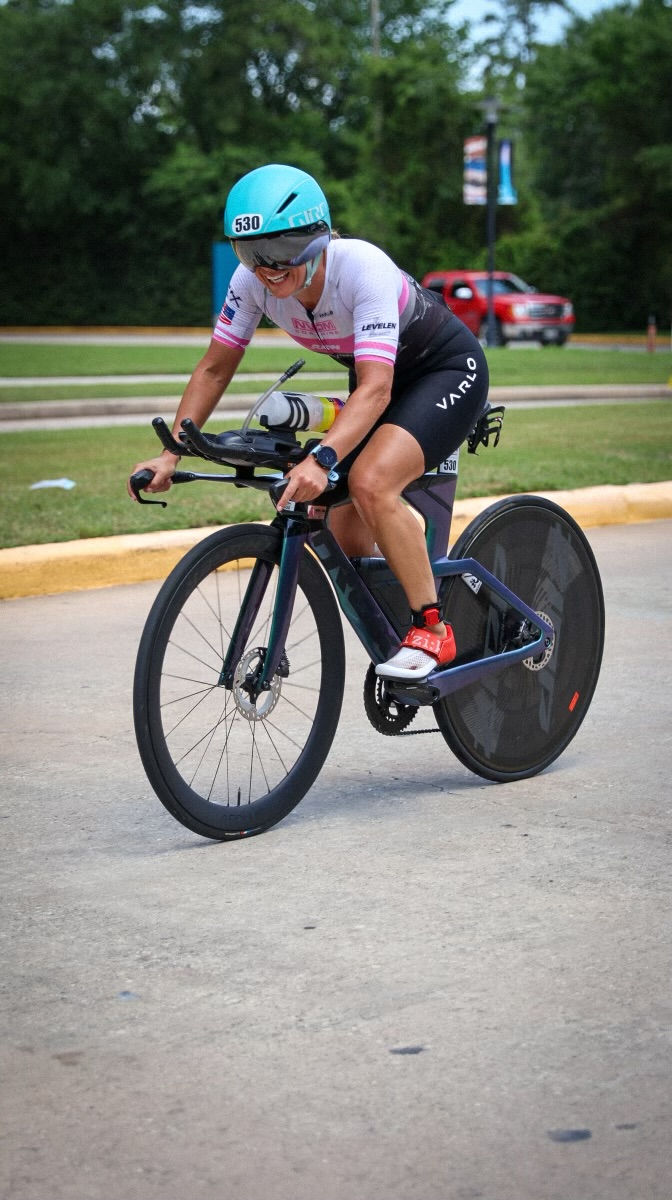
This is the most useful thing a coach can hand a first-timer. On a 56-mile bike, the limiter is very often your ability to stay in position, not your ability to make power. Being able to sustain your goal race power in the aero position is much different than sitting up with your headphones on pushing power on your indoor trainer. Your neck, shoulders and low back may have other ideas for you on race day if you don't intentionally practice race conditions in your training. Make sure to complete longer efforts, around sixty to ninety minutes, so you can arrive at the race knowing your real, tested plan for the bike.
So the highest-value bike work left is not more watts. It is progressive, uninterrupted aero holds inside your long rides — twenty unbroken minutes building toward longer efforts, without sitting up.
Pacing the bike, and what it does to your run
The widely held view across coaching is that run difficulties at this distance are usually a bike-pacing outcome rather than a run-fitness one. The run tells you what the bike did. We will not hand you a number — our bike pacing and power guide will help you with that.
Things come loose, and bottles get dropped
Expect the course to be untidy. One published Chattanooga 70.3 report describes hitting a pothole around mile five, having an arm rest come loose, losing a bottle, and re-planning hydration on the fly. These unexpected challenges are not the exception in long course triathlon, they are the rule.
What separates a calm response from a rattled one is a Plan B, so make one this week: if you lose a bottle, what happens? Know where the aid stations sit, what they are handing out, and that you can reach the next one on what is already on board. Then practice hand-offs with a teammate, because taking a bottle at speed is a learned motion.
Athlete Takeaway: Extend unbroken aero holds inside your long rides over the next six weeks, and ride one session where you take a bottle at speed and answer the question "what do I do if I drop one?"

T2 and the First Mile
You have done bricks — probably a lot. The honest gap is that most came off easy rides. Two or three runs of twenty to thirty minutes off a ride containing real race-effort work will do more for your first mile than any number of easy transition runs; the mechanics are in our post on running off the bike and T2 biomechanics. Don't make any decision on what kind of day you are having during the first mile of the run. Focus on execution, not the finish line.
Athlete Takeaway: Put two or three hard-effort bricks in the next six weeks, and treat the first ten minutes of the run as information you notice but do not act on.
The Run: What to Expect at Your First 70.3 When It Gets Real
Many negotiations happen inside your head when you're out on the run. All the decisions you have made throughout the day come back to the surface, and the result of those decisions is unavoidable. Sometime those decisions create the opportunity to walk the path of naive optimism, panic, and acceptance.
Stage one: naive optimism
The opening miles. The legs came around, the math looks great, and the temptation is to bank time. This half marathon does not reward front-loading. Run the pace you planned, walk every aid station from the first one, and fuel on the schedule you rehearsed rather than the one your stomach is voting for.
Stage two: panic
Somewhere in the middle miles the arithmetic stops working. Pace slips, the finish feels far off, and the internal commentary gets loud. This stage feels like an emergency and is not one. It is a normal feature of the distance, and it passes.
What to do is small and concrete. Shrink the race to the next aid station and nothing beyond it. Keep fueling — this is exactly where people stop, and stopping makes the next thirty minutes harder. Cold water on your head and neck, shorter stride, hold cadence rather than reaching for pace.
Stage three: acceptance
In the last third the negotiating stops. You are going to finish, and the only job left is to keep doing the thing. Many athletes describe this as the most satisfying stretch of the day, and knowing it is coming makes stage two shorter.

Late aid stations
The last aid stations of the day do not always look like the first, so plan to be self-sufficient on what you truly need. And practice the small skill: drinking from a paper cup while moving takes a pinch at the top and a slow sip. Our rundown of the 10 most common race day errors is a good broader pre-race read.
Athlete Takeaway: Name the three stages before race day so you recognize the middle one when it arrives. When it does, shrink the race to the next aid station and keep fueling — that is the whole job for twenty minutes.
The Finish Chute, and the Hour After
The last mile is loud, and most athletes remember very little of the chute itself. Take the carpet slowly enough to actually be there — you get one first 70.3 finish. Then expect the next hour to be strange: appetite is unreliable, legs get shaky, and the emotional weather swings both ways. That is ordinary after many hours of work, and it settles. Plan for your people too — a 70.3 is a long spectating day, and finish times carry a wide range even for athletes who execute well.
Athlete Takeaway: Give your support crew a wide finish window and a fixed meeting spot, and give yourself an hour of sitting down and eating before you evaluate anything about the day.
The Bottom Line
Almost everything here is a normal feature of a 70.3 rather than something to be defended against. The line is long. Transitions take longer than the math suggests. Your position on the bike gets uncomfortable before your legs do. The run moves through optimism, panic and acceptance, and the cramp ceiling arrives before your fitness ceiling does.
Knowing that in advance is most of the advantage, because the day is far easier to execute when nothing in it is a surprise. Where you can still change something, change three: extend your aero holds, rehearse the wetsuit strip tired, and run hard off a hard bike.
If you would like a coach in your corner for the last stretch of this build, we would love to hear from you. Walking an athlete through their first 70.3 is one of the most enjoyable things we do, and our coaches are at races across Texas all season. Set up a call with us now, and we will help you be ready for your best race day.