The Kona Course: Why Heat, Humidity and Wind Make the IRONMAN World Championship So Hard


At the 2014 IRONMAN World Championship, a group of researchers had 15 experienced age-group men swallow a core-temperature pill before the start. Fifteen minutes before the swim, their core temperature averaged 36.6°C (97.9°F). Near the 16-kilometer mark of the marathon, about 10 miles in, it averaged 38.6°C (101.4°F). Air temperature that day ran from about 76°F to 86°F, with humidity around 60%.
Those are ordinary October conditions in Kona. The Kona course stacks moderate stresses for 140.6 miles: warm water with no wetsuit, a long exposed ride in the wind, and a hot, humid marathon that most age-groupers run in the afternoon. This is the second of three pieces I'm writing on Kona this week. The first covered the culture of race week. This one walks through the course a leg at a time, what each leg asks of your body, and how athletes prepare for it.
Swimming the Kona Course: Warm Water and No Wetsuit
The swim is a single loop from the Kailua Pier out to a turnaround boat about 1.2 miles offshore and back. Kailua Bay usually has no surf, just small swells running parallel to the course, though 2024 brought rolling waves and jellyfish stings for several athletes. Since 2019 the race has used wave starts instead of a mass start. This year the pro men start at 6:20 a.m. and the pro women at 6:30, with the age-group waves after them.
The water usually sits right around 79–80°F. IRONMAN's age-group wetsuit cutoff is 76.1°F, so the field swims in swimskins. For most age-groupers that means a slower swim than at their home race, with less buoyancy and more work to hold body position over 2.4 miles. The swim also starts the heat load early. In a study at a half-distance race in Guadeloupe, where the ocean was even warmer at 29.5°C (85°F), athletes' core temperature rose from 37.1°C before the start to 37.8°C after the swim. Kona's water is a few degrees cooler, but the direction is the same: you get on the bike already warm.

What it means for training
Athletes who come out of the water composed at Kona have usually done their key open-water swims without a wetsuit for weeks. Swimming without the extra lift changes how your hips and legs ride in the water, and your pacing for 2.4 miles changes with it. If a swimskin is part of your race kit, train in it.
Athlete Takeaway: In the final two months before a warm-water race, swim your long open-water sessions in a swimskin or no wetsuit at all. Then treat the first 20 minutes of the bike as the start of your cooling and fluid plan.
Riding the Kona Course: Lava Fields, Hawi and the Wind
The bike leaves town and heads north on the Queen Kaʻahumanu Highway, the Queen K, through miles of black lava fields to Kawaihae, around mile 40. From there it turns onto the Akoni Pule Highway and climbs toward Hawi, about 18–20 miles away, with the steepest grades in the last five miles. The turnaround in Hawi comes around mile 60, and then the course retraces the same road back to Kailua-Kona. The most commonly published figure for total climbing is about 5,800 feet, though published figures vary by source.
The wind
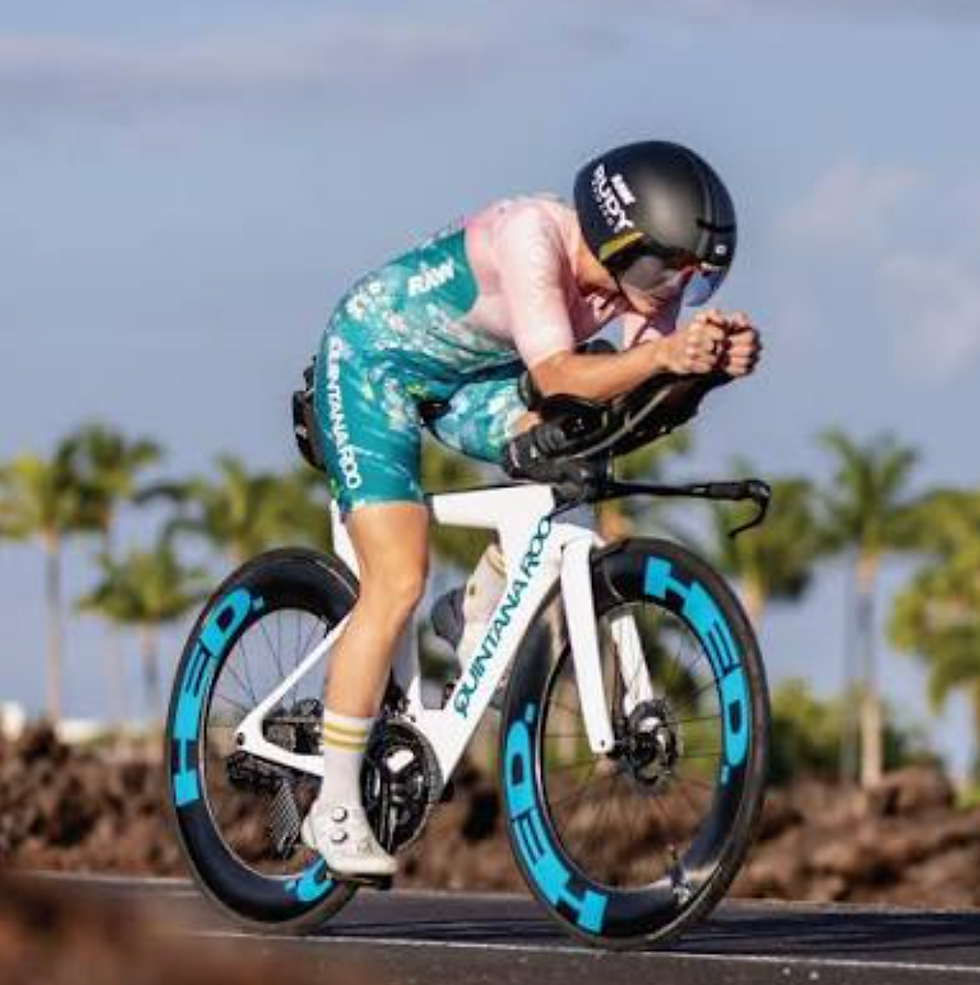
Wind is the bigger factor on this bike course. In October the trade winds typically blow from the east and east-northeast at 15–20 mph, with occasional days over 25. A WeatherFlow forecaster's course primer describes the Queen K as calm early, often under 8 mph, building to crosswinds of 5–15 mph by mid-to-late morning. Around Hawi, roughly miles 55 to 65, sustained winds of 20 mph or more with gusts above 30 happen at times, and the wind can swing from crosswind to headwind on the same stretch. On the descent from Hawi with a tailwind, Purple Patch's course preview notes speeds "well in excess of 50 mph."
The heat on the bike
October's average high at the Kona airport is about 86°F (NOAA's 1991–2020 normals). The number on paper leaves out the setting: five, six or seven hours on a highway with no shade, between fields of dark lava rock, with most age-groupers making the return trip in the hottest part of the day. Humidity adds to it. The 2015 expert consensus on competing in the heat, led by Sébastien Racinais, notes that the standard heat-stress index "might underestimate heat stress risk when sweat evaporation is restricted (ie, high humidity and/or low air movement)." Humid air makes a given temperature harder to race in. In a lab study by Ron Maughan and colleagues, eight men cycled at 70% of VO2max in a 30°C (86°F) room until exhaustion. As relative humidity rose from 24% to 80%, their time to exhaustion fell from 68 minutes to 46 minutes. A race isn't a ride to exhaustion at a fixed intensity, but the direction holds: the less your sweat can evaporate, the less work you can sustain.
Pacing and fueling for the Queen K
Strong rides in Kona usually look patient on the way out. Riders who hold back on the Queen K, ride the crosswinds in control, and keep eating and drinking on schedule have something left for the return leg, whatever the wind is doing. Heat also competes with your gut for blood flow, so the time to find out whether your fueling plan works in the heat is in training. We target 80–120 grams of carbohydrate per hour for NVDM athletes in long-course racing, and in hot conditions that target is only realistic if you've practiced it. Our guides to pacing the IRONMAN bike by power and riding a TT bike in the wind go deeper on both.

Athlete Takeaway: Rehearse your full race fueling and fluid plan on your hottest long rides, and set a power ceiling for the first half of the bike that leaves room for whatever the wind does on the way home.
Running the Kona Course: Aliʻi Drive, Palani and the Energy Lab
The marathon starts with an out-and-back along Aliʻi Drive, turning around near mile 3.5 and coming back through town. Around mile 10 it climbs Palani Road, a short, steep hill, to reach the Queen K. Then it heads out the highway to the Natural Energy Laboratory of Hawaii Authority, the Energy Lab, which takes up roughly miles 16 to 19, and comes back down Palani near mile 24 to the finish on Aliʻi Drive. Published figures put the run's total climbing at about 1,000 feet.
That 10-mile mark is about where the 2014 study took its marathon measurement, at an average core temperature of 38.6°C. Coaches who know the course often single out the Energy Lab as one of the hottest stretches of the day.
The timing makes it harder
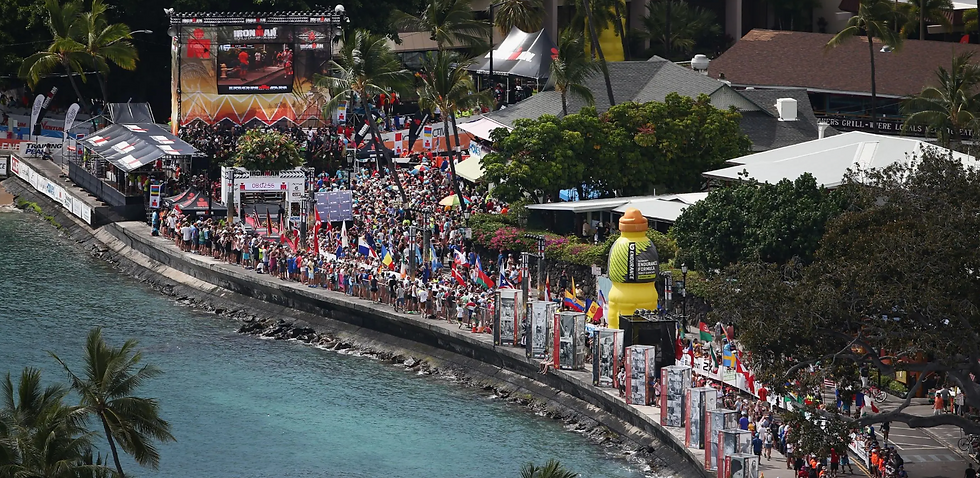
The pros finish in daylight. Age-groupers race a different day. Average age-group finish times have been around 12.5 hours for men and a little over 13 hours for women in recent years, so a typical age-grouper, starting in one of the waves shortly after the pros, begins the marathon in the middle of the afternoon. Sunset on race day is a little after 6 p.m. A large share of the field runs through the hottest hours, then finishes in the dark.
Running well in Kona heat
The athletes who run well here usually pace to conditions from the first mile and treat every aid station as a cooling stop: ice in the hat or down the suit, sponges, cold water over the head and arms, then fluid and carbohydrate. That routine matters more in humidity, because sweat that drips off you does far less cooling than sweat that evaporates. Our posts on adjusting your pace for heat and humidity and IRONMAN marathon pacing cover the numbers.

Athlete Takeaway: Build an aid-station routine you can run without thinking (ice, sponges, fluid, carbohydrate, in the same order every time) and practice it in your hottest long runs until it's automatic.
Preparing for Kona Heat When You Don't Live in It
Most athletes racing Kona don't train in Hawaiian conditions, and the research on heat acclimation is encouraging for them. The Racinais consensus reports that most adaptations come in the first week of heat exposure, with smaller gains over the following two weeks. It recommends ideally more than two weeks of sessions of at least 60 minutes a day, training in conditions like the race venue or, if that isn't possible, indoors in a hot room. It also notes that acclimating in humid heat produces different responses than dry heat, which matters for a humid race like Kona, and that adaptations fade more slowly than they build, with most of the benefit lasting two to four weeks.
For a Kona athlete, that usually means a block of heat sessions at home before travel, with sessions that match Kona's humidity as closely as you can, then arriving early enough to keep the adaptations going on the island. Our heat acclimatization protocols and our guide to preparing for a hot race from a cooler climate lay out session-by-session options.
Athlete Takeaway: Start a structured heat block two to three weeks before you travel, make the sessions humid if your race will be, and plan your arrival so you're still getting regular heat exposure in the final week.

The Bottom Line
The Kona course is hard because of the combination: warm water with no wetsuit, 112 miles of exposed highway in the trade winds, and a marathon that most age-groupers run through the hottest part of the day. Each piece is manageable with specific preparation. When you watch on Saturday, keep an eye on two places: the return from Hawi, where the wind shows who paced the first half well, and the Energy Lab, where the heat shows who managed it. Friday's final piece in this series tells the story of two of the most famous races ever run on this course.
If you have a hot race on your calendar, or a Kona goal you're building toward, set up a call with us now, and we will help you be ready for your best race day!